
Haryana will be India’s first developed state, Saini vows before President Murmu
 Aayush Goel
Published
Updated
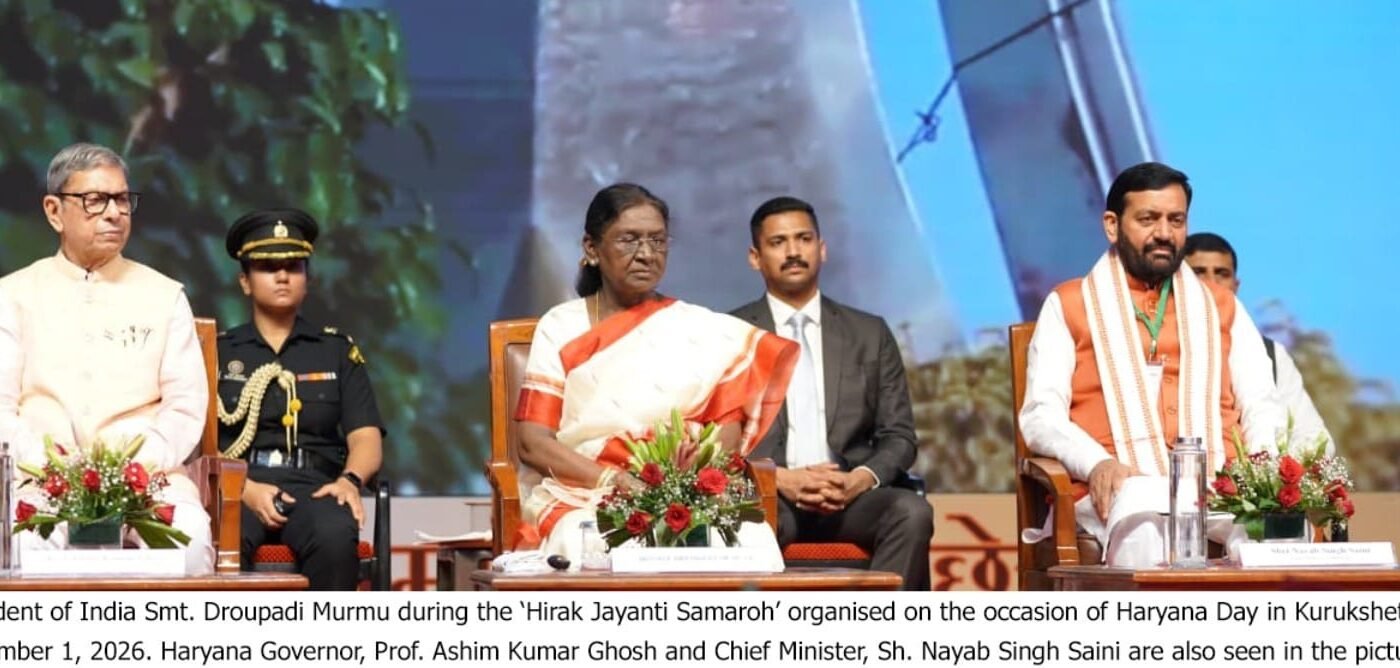
Chandigarh. In the presence of President Droupadi Murmu, Chief Minister Nayab Singh Saini on Sunday set Haryana the goal of becoming the first state in the country to reach developed status. Murmu was chief guest at the Haryana Day diamond jubilee celebrations at Kurukshetra University, marking 60 years of the state.
The President used her address to bring up a forgotten chapter of Haryana’s past. She asked the state government to document the role of a 12-year-old girl from Rewari who joined the Civil Disobedience Movement in 1930, broke the British salt law and gave her savings to the freedom struggle. The girl, Murmu said, had put aside two paise every day for years before donating the whole sum. She urged the government to “collect detailed information about this inspiring episode and bring it before society.”
President hails Haryana’s daughters and soldiers
Murmu said Haryana’s history was not only about its soldiers; its people had also taken part in large numbers in national movements. She called the state a land of bravery and spirituality, and said the Gita’s message, given in Kurukshetra, had reached the whole world and still guides humanity.
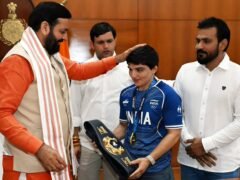
Naming shooter Manu Bhaker and boxers Saweety Boora and Jaismine Lamboria, she said the success of Haryana’s daughters was a matter of national pride. She also credited the state’s soldiers for guarding the country and noted Haryana’s role in building national infrastructure, including the railway network.
From Uparbeda village to Rashtrapati Bhavan
Welcoming the President on behalf of the government and the state’s nearly 2.75 crore people, Saini said her rise from Uparbeda village in Odisha’s Mayurbhanj district to the country’s highest constitutional office showed the strength of Indian democracy and the dignity of the Constitution. Her story, he said, gave the country’s daughters, poor families and tribal communities the hope and confidence to chase their dreams. Her presence, he added, would inspire every girl who dreams big.
Kurukshetra holds a unique place in India’s spiritual and cultural life, Saini said. It was here that Lord Krishna gave Arjuna the message of duty, courage and public welfare. He recalled Murmu’s visit to the International Gita Mahotsav in 2022, where she had called the Gita a spiritual light for humanity and a guide for life. Her presence on this land, he said, made the day a matter of special pride for Haryana. Governor Prof Ashim Kumar Ghosh was also present.
Why Saini thinks Haryana can get there
Saini said six decades of progress had laid the ground for the developed-state goal. Haryana would pursue it while taking a lead role in Prime Minister Narendra Modi’s mission of a developed India by 2047 (Viksit Bharat-2047), he said.
The CM’s case rests on the state’s economic weight. Haryana covers just 1.34 per cent of India’s land but contributes nearly 3.6 per cent of the country’s GDP, he said. Among major states, it has the highest per capita income. Governor Ghosh put that figure at about ₹3.95 lakh, in line with the state’s Economic Survey for 2025-26.
Two of every three passenger cars made in India come from Haryana, Saini said, as do every second tractor and six of every 10 motorcycles. The state also accounts for more than 60 per cent of India’s basmati rice exports. Factory output and farm exports together, he said, showed how much Haryana adds to the national economy.
Development, but on Haryana’s terms
Saini attached a condition to the goal. The push for developed status must not cost Haryana its character, he said. Economic progress has to go with compassion, development with brotherhood, and modernisation with respect for the state’s values and traditions. That balance, he said, was Haryana’s true identity and its legacy for future generations.
He thanked those who shaped modern Haryana and said the gains of 60 years must now be carried forward with fresh resolve.
A record of firsts
To show the state can lead, Saini pointed to what it had done before others. Haryana was the first state to buy all crops at minimum support price (MSP), he said. It also led the way in freeing villages from Lal Dora limits (old village land zones where residents had no formal ownership papers) and in setting minimum education qualifications for panchayat members.
India’s first hydrogen train has run between Jind and Sonipat, he said, and the country’s first elevated railway tracks were built in Rohtak and Kurukshetra.
The people behind the push
Haryana was carved out on November 1, 1966, and was once seen as a backward region, Saini said. Its farmers, workers, industrialists, traders, sportspersons and women had since made it one of India’s leading and fastest-growing states.
Hardworking farmers, brave soldiers, top athletes and empowered women define Haryana, he said. Its daughters were making the state proud everywhere, from farms and sports grounds to the armed forces and startups.
He credited farmers for their share in the country’s foodgrain stocks and livestock farmers for the state’s milk output. He quoted a popular Haryanvi saying: “Desan mein des Haryana, jit doodh-dahi ka khana.” It means: of all lands, Haryana is the finest, where milk and curd are the daily meal.
Saini paid tribute to Haryana’s soldiers guarding the borders. The state’s athletes, he said, had won 11 medals at the Commonwealth Games and 32 at the Asian Games. Every time the Tricolour went up abroad, it reflected talent raised in Haryana.
Chief Secretary: progress despite limited resources
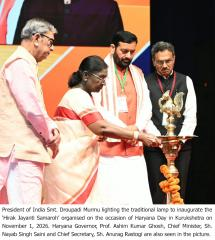
Welcoming the President on behalf of the government and people of Haryana, Chief Secretary Anurag Rastogi said her presence was an inspiration to all. The diamond jubilee, he said, was a chance to celebrate six decades of hard work and shared success.
Haryana started out in 1966 with limited resources and weak infrastructure, Rastogi said, but had since made major gains in agriculture, industry, education, sports and entrepreneurship. The state had built a distinct identity through sheer hard work and remained a key contributor to India’s foodgrain stocks. He credited Haryana’s farmers, soldiers, workers, teachers, scientists, sportspersons, entrepreneurs and every citizen for it.
Comments