
Delhi BS4 ban: ₹68 lakh in fines on day 1, none of it set aside for clean air
 Aayush Goel
Published
New Delhi: Commuters from Noida, Gurugram and Faridabad paid twice on the first day of Delhi’s winter curbs: in hours lost at the border and in ₹10,000 fines. Delhi imposed ₹68.4 lakh in penalties on Sunday, but that money goes into the government’s account, not to the police and not to any fund meant for cleaning the air. And on Monday morning, Noida’s air was worse than Delhi’s.
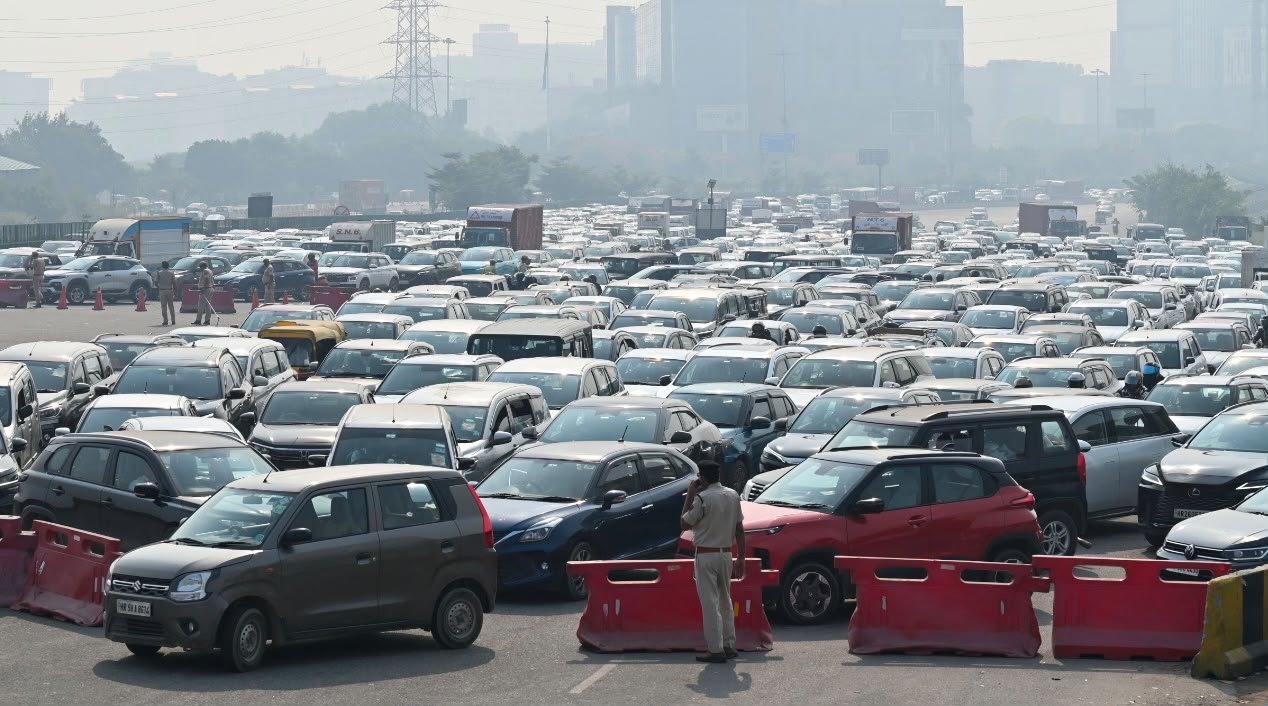
At Gurugram’s Sirhaul toll plaza, the queue stretched up to 5 km and NH-48 stayed jammed for five to six hours as about 50 police personnel checked vehicles one by one.
“My vehicle was fully compliant, but the time it took me to reach my workplace was enormous,” Sahil Bhardwaj, who works at a hotel in Delhi’s Aerocity, told Haryana Standard. He blamed drivers who ignore the rules: “People know the rules and regulations, yet they still avoid following them.” Another commuter, whose documents were all valid, said, “People do not value the time of others who are also stuck in the jam.” Several drivers who were challaned declined to comment when asked why they had not followed the rules.
Where the money goes
A Union home ministry reply in the Lok Sabha said Delhi Traffic Police fines have gone to the Delhi government since 2013, so the question of police using them “does not arise”. An RTI reply confirmed that the money lands in the Delhi Transport Commissioner’s account. Delhi has no published rule setting aside any share of it for road safety or pollution control, and Haryana Standard could not find any public record of how it is spent.
UP and Haryana at least route part of it somewhere specific. In Noida and Ghaziabad, half of each year’s fine collection later moves to a road safety fund for signboards, ambulances and traffic equipment. In Gurugram and Faridabad, fines go to the Haryana treasury. Haryana collected ₹69.36 crore from 43.49 lakh challans in 2025, and its road safety committee approved ₹74.5 crore for 2025-26, largely for CCTV, ambulances and school-zone safety. A parliamentary committee has recommended that states use traffic penalty money for road safety, but none of the three ties PUC fines to pollution control.
Delhi does have a dedicated pollution fund, a green charge on trucks, but has spent only ₹781.51 crore of the ₹1,935.44 crore collected. More than ₹1,150 crore lies unused. A CAG audit tabled in August also found collection records missing for 280 days.
Does it clean the air?
Vehicles matter. They caused 46% to 53% of Delhi’s local PM2.5 during last winter’s peak, according to the Centre for Science and Environment. But a car turned back at Delhi’s border does not leave NCR. At 7 am on Monday, Noida’s AQI was 308, slightly worse than Delhi’s 307. Ghaziabad was at 276 and Gurugram at 225, while Faridabad stayed moderate at 118.
Why Haryana and UP are not as strict
The rules differ. Delhi’s ban on outside vehicles below BS-VI is part of its own winter plan. CAQM’s GRAP allows Gurugram, Faridabad, Ghaziabad, Noida and Sonipat to restrict BS-III petrol and BS-IV diesel cars only at Stage III, when the air turns “severe”. Delhi-NCR has been under Stage I since October 21. So a car sent back from Delhi can legally run in its home city. Haryana has used this power before, banning these cars in Gurugram and Faridabad under Stage III in November 2023.
The scale is also large. More than 10 lakh vehicles are barred from Delhi: over 4 lakh in Noida and Greater Noida, about 4 lakh in Ghaziabad and nearly 2 lakh in Gurugram and Faridabad. Transporters say 60,000 commercial vehicles from Gurugram alone could be shut out, putting ₹10,000 crore worth of goods movement at risk.
The neighbours have acted in other ways. Haryana and UP brought “No PUC, No Fuel” to their NCR pumps from October 1, though Haryana’s pumps still check by hand because its camera rollout was incomplete. Noida seized more than 650 end-of-life vehicles in September. Haryana Police are also helping check vehicles at the Gurugram border. But enforcement against pollution remains thin. Gurugram issued 36,518 challans in one week in early October, only 671 of them for pollution, compared with 493 PUC challans by Delhi Traffic Police on Sunday alone.
What Delhi and CAQM are doing
Delhi’s Winter Action Plan enforces “No PUC, No Fuel” at all 500 fuel stations using number-plate cameras that also flag end-of-life vehicles. It bans outdoor construction from November 1, with a total ban from December 10 to January 20, doubles parking fees until February 28, and requires half of office staff to work from home with staggered timings. It aims to raise Metro ridership from 6.5 million to 7.2 million a day and DTC ridership from 3.7 million to 4.2 million.
CAQM’s revised GRAP now bars inter-state buses from entering Delhi-NCR unless they are electric, CNG or BS-VI diesel, even at Stage I. Curbs on diesel generator sets also start earlier. The exemption for older goods vehicles carrying essential supplies has ended. From November 5 to 20, a period that includes Diwali, CAQM has ordered offices in Delhi, Gurugram, Noida, Faridabad, Ghaziabad and Sonipat to work at half strength and halted dust-generating construction across NCR.
What commuters need to know
Petrol and diesel vehicles registered outside Delhi and below BS-VI cannot enter until January 31, 2027. BS-VI, CNG and electric vehicles can, with a valid PUC certificate. Driving without one costs ₹10,000. You get 45 days to pay or contest a challan, but must deposit half before going to court. Sunil Kumar, who drives from Gurugram’s Sector 104 to Dwarka, told PTI that cabs could cost him ₹500 to ₹1,000 extra a day.
Environment Minister Manjinder Singh Sirsa said on X: “Keep PUC valid, follow entry rules and dust norms.”
Quick answers
Can a BS4 car from Noida or Gurugram enter Delhi? No, not until January 31, 2027. CNG and electric cars can.
What is the fine for no PUC? ₹10,000, and pumps across NCR can refuse fuel.
Does challan money fund pollution control? No. In Delhi it goes to the government’s account. In UP and Haryana, part of it goes to road safety funds.


Comments