
Diwali crackers added just 6% to Gurugram AQI
 Aayush Goel
Published
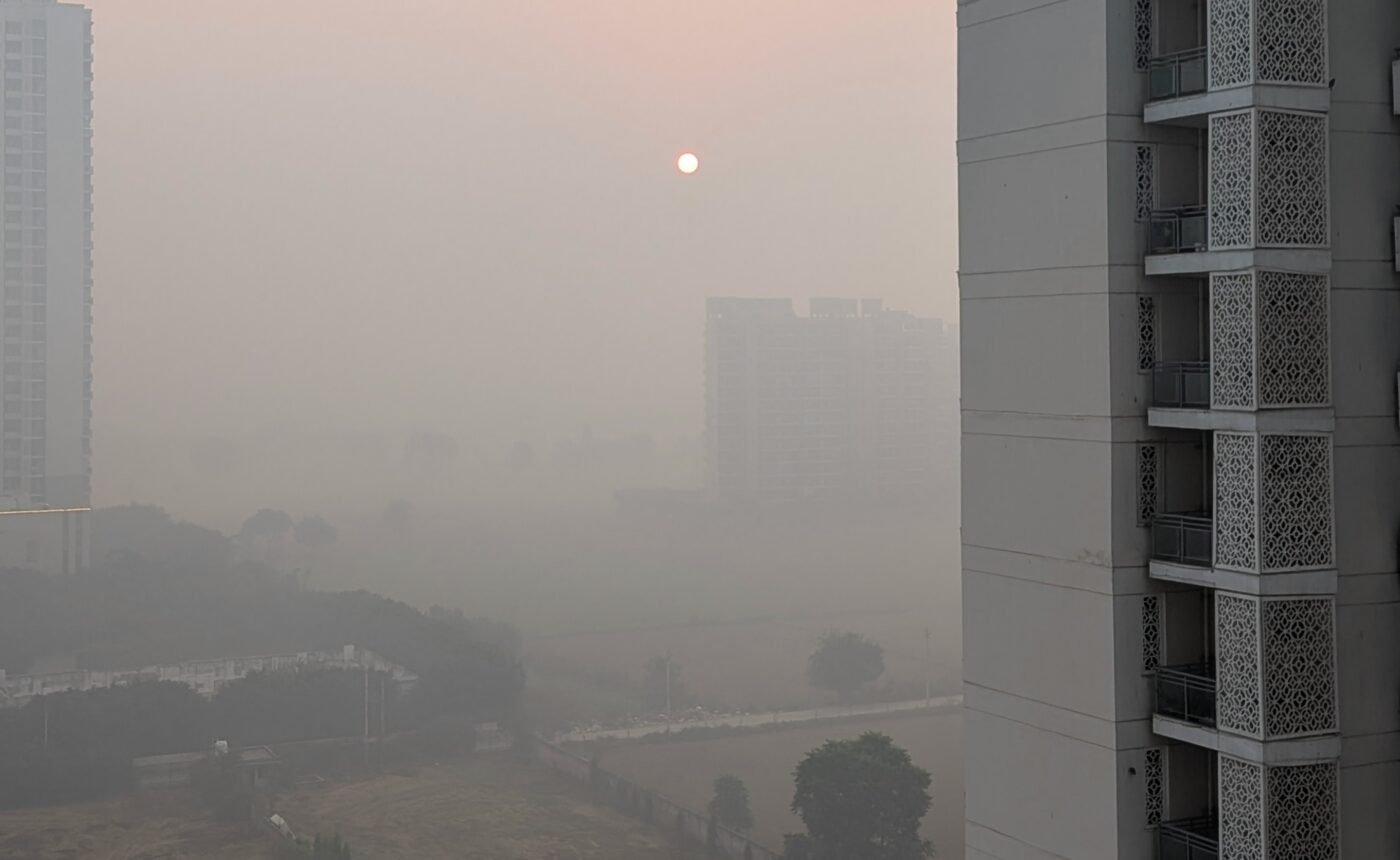
Chandigarh. Gurugram’s AQI rose by the smallest margin in three years over Diwali, because the city’s air was already close to “very poor” in the week before the festival, a three-year study of Central Pollution Control Board (CPCB) data shows.
Compared with the week before, Gurugram’s Air Quality Index (AQI) rose 6% over Diwali day, November 8, and the day after. The rise was 48% in 2024 and 38% in 2025. But the air was no cleaner. The two-day Diwali average was 316, worse than 302 in 2024, though better than 332 in 2025. The worst day reached 345, the third year in a row that Gurugram’s festival peak has been in the “very poor” category, after 309 in 2024 and 370 in 2025.
The pre-Diwali average, from November 1 to 7, was 300, one point below the “very poor” mark. It was the highest in three years, up from 204 in 2024 and 241 in 2025.
The study is by the research group Climate Trends. It compiled about 2.48 lakh city-day records from CPCB’s daily National AQI Bulletins, covering January 2024 to November 9, 2026. It compared AQI in the week before Diwali, on Diwali and the day after, and in the week after, across nine cities: Delhi, Gurugram, Lucknow, Patna, Chandigarh, Mumbai, Hyderabad, Bengaluru and Chennai.
Was this a cleaner Diwali in Gurugram?
No. The study says the seasonal pollution across the region, not fireworks, set this year’s Diwali levels in Delhi and Gurugram. It does not say people burst fewer crackers. It notes that the festival’s own share of the pollution is the hardest to separate out in Delhi-NCR.
Delhi shows the same pattern more sharply. Its AQI rose only 4% over Diwali this year, its smallest jump in three years, down from 44% in 2025. Yet its Diwali average reached a three-year high of 360, up from 334 in 2024 and 348 in 2025. The study says current controls are “not yet bending the curve there”.
Why was Gurugram’s AQI so high before Diwali?
After the monsoon withdraws, nights turn calm and cool. The air stops mixing upwards, and a layer of warm air traps smoke close to the ground. Paddy stubble burning in Punjab and Haryana also peaks in these weeks. Its smoke drifts down the Indo-Gangetic Plain towards Delhi-NCR.
The date made it worse. Diwali fell on November 8 this year, against October 20 last year, which put it closer to the peak of stubble burning. In neighbouring Delhi, AQI rose from 117 on October 31 to 382 on November 6.
Is GRAP Stage 3 in force in Gurugram?
Yes. The Commission for Air Quality Management (CAQM) brought in Stage III of the Graded Response Action Plan (GRAP) across Delhi-NCR on November 6, two days before Diwali, as a precaution. That same day, CPCB’s bulletin put Panchgaon in Gurugram district at an AQI of 426, news agency UNI reported. That was the highest among the 278 cities and locations monitored that day. Until November 20, Gurugram offices may have only half their staff on site, and dust-raising construction and demolition is restricted.
Will Gurugram’s AQI improve after Diwali?
Past years give mixed answers. In 2024, Gurugram’s AQI in the week after Diwali averaged 281, still far above its pre-Diwali level of 204. In 2025, it fell to 212, which is 12% below the pre-Diwali level. That made Gurugram the only north Indian city in the study to recover that year. Data for the week after this Diwali is not yet available, because the dataset ends on November 9.
The weather may bring some relief. “An impending Western Disturbance could offer some temporary relief from persistent pollution across north India over the next 24–48 hours,” said Dr Surendra Kumar Dhaka, Professor, Department of Physics, University of Delhi. If the system holds, he said, changes in wind, better mixing of air and possible rain could clear or wash out pollutants. “Even if air quality improves temporarily, the underlying seasonal pollution burden across the Indo-Gangetic Plain is likely to remain a concern,” he added.
Which cities recovered fastest after Diwali?
Southern and coastal cities cleared up quickly. Chennai and Hyderabad fell back to or below their pre-Diwali AQI within a week in both 2024 and 2025. Mumbai and Bengaluru did so in one of the two years. In 2025, Mumbai’s average for the week after Diwali dropped to 71, less than half its pre-Diwali 129. In 2024, Chennai’s fell to 71, against 108 before Diwali. Bengaluru and Hyderabad never went beyond “moderate”, with peaks between 97 and 135.
In the north, the air mostly stayed bad. In 2024, Delhi’s AQI was worse in the week after Diwali (366) than during the festival itself (334). Patna showed the same pattern, at 237 against 190.
The biggest jumps came in cities that started with cleaner air. This year Chennai’s AQI rose 139% over Diwali and Patna’s rose 110%. Mumbai and Hyderabad each rose 64%, Lucknow 59% and Bengaluru 53%. Hyderabad and Bengaluru had cleaner air before Diwali than in 2024, yet this year’s jump was their largest in three years. In 2024, Chennai peaked on Diwali day itself, at 213 on October 31, because Tamil Nadu bursts crackers on the morning of Naraka Chaturdashi. That same year, Lucknow (306) and Chandigarh (302) also reached “very poor”.
“The key takeaway is that a short-term pollution spike need not translate into a prolonged episode,” said Dr Palak Balyan, Research Lead, Climate Trends. She said sea breezes, stronger winds over the Deccan plateau and seasonal rain help cities like Chennai and Hyderabad clear their air fast. Cities on the Indo-Gangetic Plain face low winds, trapped air and crop-residue burning, which can drag pollution out. “Region specific air quality management and a clear understanding of the factors that support air-quality recovery can help cities build greater resilience,” she said.
What changed in Chandigarh?
Chandigarh is the one city in the study whose air clearly got cleaner. Its pre-Diwali average fell from 191 in 2024 to 82 this year. The study says this may be due to fewer farm fires in Punjab and Haryana, or to different weather in those weeks. It says the data cannot tell the two apart and needs to be checked against fire counts and weather records.
What does the study recommend for Delhi-NCR?
The study asks cities on the Indo-Gangetic Plain, including Delhi-NCR, to treat Diwali as part of the October–November pollution season. It says GRAP-type curbs and stubble-burning controls should start before the festival, not after it. All cities should issue health advisories for Diwali day and the day after, when AQI peaks, and protect people most at risk. For southern and coastal cities, it suggests green crackers and the 8–10 pm window, because fireworks cause most of their Diwali spike. It also calls for hourly PM2.5 tracking and source studies to separate fireworks, crop smoke and weather.
What the study does not cover
The study notes its limits. CPCB’s city AQI is a 24-hour average that ends at 4 pm, so the short night-time spike from crackers gets averaged out across two days. The study did not include weather or farm-fire counts, so it cannot separate the festival’s share from weather and stubble smoke. It also used one Diwali date for all cities, although the festival dates differ by region.
Comments